If there is one thing I think we should have picked up on by now it is that we can’t trust what Russia is saying. We have inadvertently been victims of Russian propaganda and now it is time to take a bath and clean up our understandings. This is something that we were not previously aware of but that is becoming increasingly obvious. We need to start looking at what Russia actually is doing.
It has become increasingly clear that there are significant differences between Russia and Ukraine. But is it possible to investigate a bit deeper what these differences are?
A slave mentality
Through conversations with my Ukrainian friends and while traveling in Ukraine as a music composer both before and during the war, a theme has come to the forefront on several occasions.
It is hard, bordering on impossible, to draw all-encompassing conclusions about the nature of societies, and Russia and Ukraine are particularly hard in this regard. But even if we don’t see the whole picture, we can still look at individual pieces of the puzzle.
The idea that Russia is a mystery beyond understanding (in the words of Churchill) and that its uniqueness makes it impossible to gauge or critique (in the words of Putin) is less than helpful. This is no longer something we can hide behind.
Recently, when I was traveling in Ukraine I heard a story of a Russian commander asking the inhabitants of a small occupied Ukrainian village “Who is the tsar here, who makes the decisions? I want to talk to him!”
The Ukrainians looked at him with slight bewilderment and said “We all make decisions here, we are all leaders”. The Russian said “Impossible! This is not how it works!” A top-down society will naturally struggle to understand a more egalitarian one. It might even feel threatened by its organic nature.
My historian friend in Chernigiv says that Russian society is built on the idea of servanthood, that you are brought up to serve the state. The way it works is that your life is, by design or general lethargy, often not good in many cases, sometimes because there is little point in working hard for something you might not reap the rewards for. You then have to find pride in something else that is bigger than yourself, and often this would be attaching your self-worth to the Russian grand narrative.
This narrative is one of superiority, often with a spiritual quasi-church-based overlay, and sprinkled in the idea of being the dominant force. This in turn gives the state enormous power over the individual. Russia is, both on an individual and collective level, simultaneously strong and threatened, and this paranoia creates the ghost it fears.
The Russian people are unaware of other ways of thinking about themselves and the world, which leads to them being unable to take off the distorted glasses they read world news through, as the officer in the Ukrainian village mentioned above.
Since they often link their self-worth to the state, they consequently go down with the ship. Being a voluntary slave that is tied to the mast of the Russian ship is a guarantor of your self-worth. When Russia dominates other nations the people feel strong, respected, and important.
In this way, the strength of the empire is built on boosting the ego of its people by growing the empire itself. Hence it is fundamentally unstable at its core.
A culture of violence
In Russia, there has been a culture of violence, both physical and verbal. This is combined with an understanding that you are either the giver or receiver of violence. This has the perverse consequence that if you are not the giver of violence in some way, you are de facto a receiver and a victim. Hence you are compelled to start handing out violence. A middle ground does not quite exist.
We can see the consequences of this with Putin himself, with the actions of Russian soldiers, and in how people treat each other in society.
This creates a society of fear and suspicion where you don’t trust others because you know how you would behave in the same position. Low self-esteem leads to violence that leads to suspicion that leads to low self-esteem that leads to violence.
The saddest part is when people choose, out of fear or complacency, to become slaves. It is a comfortable choice because you don’t need to take responsibility. You mostly get what you need, and you only need to give up your freedom. It leads to a subservient society, that is easy to control and direct. Russians seem to choose this in large numbers, while Ukrainians do not.
When I was in Chernigiv not long ago I saw the place where there once was a statue of Lenin. There were now a multitude of tulips in its place, a poignant difference between the cultures. A functional democracy cannot be built by people who choose to become slaves.
Slaves who become kings and who still have slave mindsets are lethal, as history has shown us. If you get to a place of power and still keep the identity of victim or inferior, you will be dangerous. In the West, we too need to let go of our issues in this regard, and Russia has an even longer way to go.
Holodormor (Голодомор) is the artificially induced famine that killed millions of Ukrainians in 1932/33, the literal meaning being “death by hunger.” It still is vividly alive in Ukrainian self-understanding. A more long-term and overarching understanding of the inflictions of the Russian state can be labeled as Hollopdomor (Холопдомор). The old word hollop means slave which in turn translates Hollopdomor as “death by slaves” or “death by slave mentality.”
Not an isolated example
Russia serves as an example of what happens when we don’t become aware of our own national wounds. Eventually, they will all lead us into victimhood or domination of others.
The “make my country great again” trend is an example of this. It happens in states that we were once great and that we think deserve to still be great, alongside a particular idea of what it means to be great. In most cases, this means being dominating. Brexit can be seen as a national wound resurfacing, and Germany will need to face its own ghosts to truly embrace the Zeitenwende that Schultz has heralded.
We need to form dynamic societies where honesty and vulnerability are virtues, and where sharing opinions in constructive manners is an act of necessity. Forgiveness, grace, and transformation need to become practical words with hands and feet. They need to come down off the shelf of abstract ideas and concepts into the practical world. Otherwise, we might fall prey to similar acts of voluntary slavery.
It is not beyond our reach, and reach for it we must.
There is currently a war in Europe, there are wars in other parts of the world. We are at the brink of a famine, there is a climate and environmental disaster looming. The UN with all its satellite NGOs and state-run agencies is central to the work trying to alleviate this coming onslaught of disasters. I went to one of the hubs of the UN for the Geneva Peace Week as a film composer trying to see what this place was about and if there was any overlap with my creative projects TRACKS, BARDS and FLYT. Surely, we are in a storytelling age?
First I met a Brazilian taxi driver who in no uncertain terms let his steam out. He said there is no life here, they think they are rich but they are poor, I am going back to Brazil in January. At least he knew how to talk without leaving open the option of being interrupted open, something that might be a good skill to have in a town of many words.
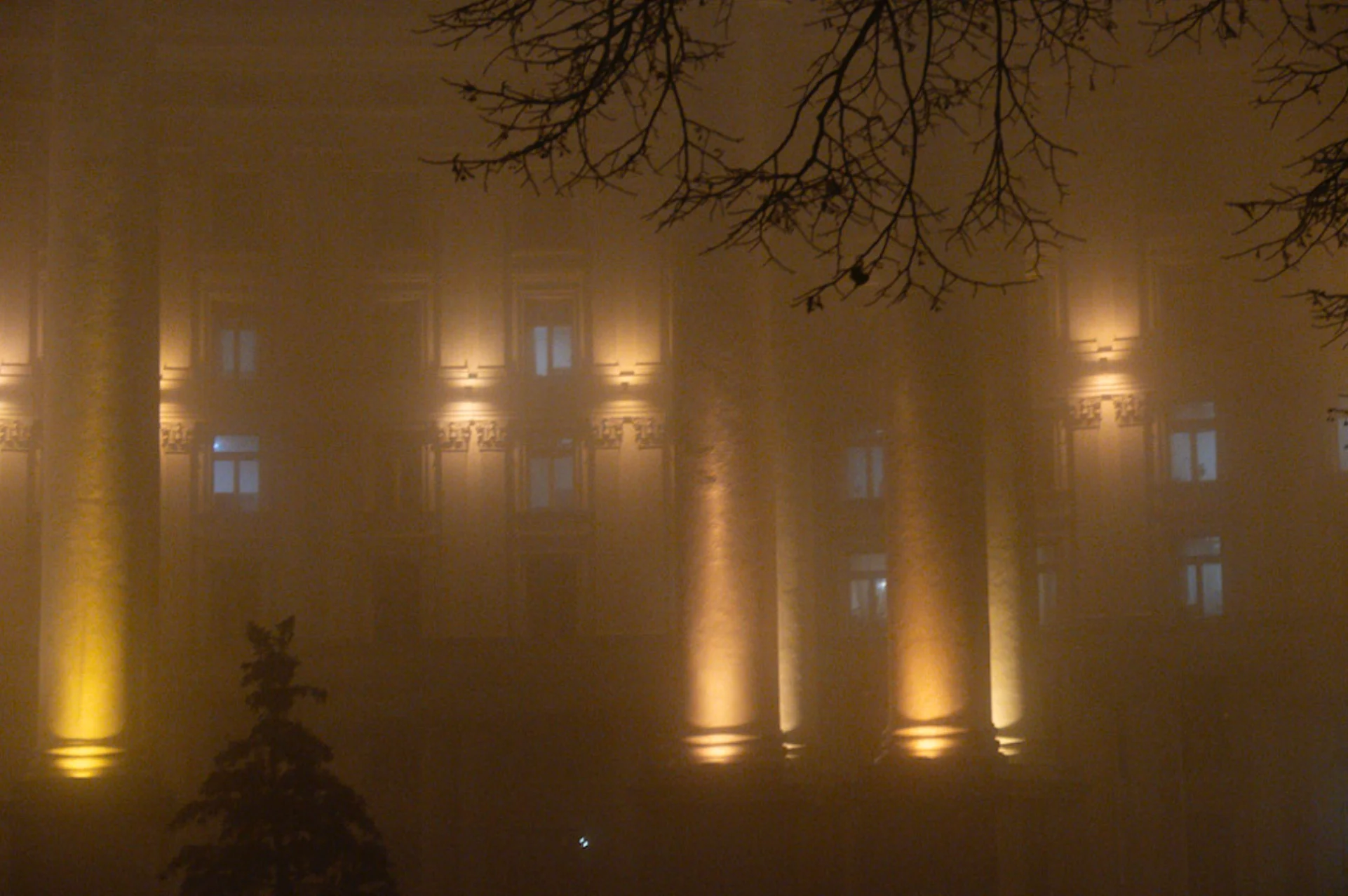
Geneva is made of glass and shiny objects that speak of vision, power and on a good day transparency. There is an odd lack of street life, be it along the lake with the banking towers or around the UN a bit further up. I had a sense of people being brought up in a system of a certain jargon that bounces around off these shiny buildings, and that is being echoed up and down the elevators and escalators. The dizzying jungle of abbreviations feels like it is designed to keep the non-initiated on the outside, until I spoke with someone on the inside who said they also felt confused. Language matters, but actions matter more.
Every morning there is a long queue of cars from France into Geneva. The prices are rather inflated in Geneva due to the nature of the organisations present here and this makes it necessary for some to shop and live outside. This city feels distinctly artificial in a very beautiful way and speaks of a game that needs to be played, maybe not so different from other places in the world. Geneva to me felt like an island in some strange way.
There is naivety in the political world that funding solves all problems. But behind the nice academic jargon I heard a need for solid trustworthy people on the ground. But these people will not just magically appear even with the solid amount of money thrown after them. In some cases, they are not even interested in money as it can corrupt and make them less agile. The Midas touch might not always be splendid if you are in need of food.
The funny thing is that it feels like a game of hiding, where objectivity inside political or academic cliches is being touted as the holy grail, but in many eyes, I saw remnants of childish belief in a better world. I looked around with a silent question, at which time in your life did you suddenly get filled with hope? What happened then, when did you believe in a better future, I hope you have not forgotten. Until I know when you changed, I cannot trust you. So, tell me your story, and I will tell you mine.
At one workshop we as the audience were challenged to reflect back what we thought was missing in an academic analysis of digital tools in a peace context. As the echo chamber fed back its normal words, I suggested that we might need better storytelling, and the room agreed in a distinct and slightly surprised murmur. Later in the day this moment was mentioned as a word that had not been mentioned in these circles before. The elephant in the room had spoken. I felt honoured to be the person to surprise people just by being in the wrong place in the right way. In a world based on control, surprise is a real currency.
The UN is important, with all its ecosystems and I met many absolutely fascinating people in Geneva. If the UN could reflect the real world and the real heaven it is there to serve and reach for, it would be more powerful in my view. I think we need more odd people present there, I would love to bring more artists there and maybe the jargon could be more emotional and storytelling-based. Every system builds pride into its core principles and artists are no different from academics or politicians in this respect. However, we need to lower our guards and unprotected venture across the street or maybe down to the party of the people down in the square.
It’s a new age, it’s the return of an old age, it’s a challenge for all of us and we are all inside some kind of glass cathedral. There is no point in sitting inside your own protective sphere and point fingers. The problem belongs to all of us and the solution also. I encourage all of you to go to places where you feel completely out of your depths and stay until it makes sense. I tried it a bit this week and came away exhausted and encouraged. We are all people looking for a language in the noise, a path in the fog. There is no time for blame but rather for ruthless encouragement to seek a living truth. And maybe the longing for freedom will lead to actual peace, and the path is paved with stories of transformed hearts.
I believe in people, inside the NGO/UN bubble or outside, but mostly when people are honest and dare to be people, not facades. Sometimes in the facades we can see reflections of heaven but heaven in someone’s heart is always better.
War is machine versus people, metal versus skin. It is very practical, concrete and matter-of-factly. Coordinates in, death out, no problem. Job done big missile or little bullet, onto next objective to be eliminated. It is inhuman in a machinelike manner, it rolls right over humanity both in the attacker and the attacked, and feels nothing. It doesn’t say hi, it doesn’t say bye, it doesn’t ask you how you feel. It is precisely this; life-less, not dead, it never was alive in the first place. It is the ultimate failure of human relations. It calculates coldly, it has no soul. And when faced with the icy calculating coldness of industrial warfare comes the sense of someone else living your life, that you are passenger on a runaway train. If it doesn’t kill you straight up it will get you in the end, this is the second death. We all run the risk of becoming passengers on this train.
Things almost always look different close to the subject than through the telescopic distance of the news. I felt I had to come back to Kyiv and meet my friends and see for myself. I lived in Kyiv from September 2021 to January 2022 and visited places like Mariupol, Kherson and Kharkiv. Now I felt it was time to go back.
Leaving Poland on the train bound for Kyiv was like entering a fog of the unknown. What would it look and feel like when inside, would I meet a total mess there? Would it be darkness, chaos, despair? No internet on the train that went through the night almost made it more surreal. Dark, unknown, maybe a cruise missile could sneak through the anti-missile defence system? Sitting ducks on a train where someone somewhere with a complete lack of empathy in a bad mood just might feel like pushing that button.
The journey to Kyiv is pretty taxing, not because it’s long but because it’s uncertain. Even for me, with no real risk and stakes, this was not a normal journey. I could only imagine how it might have been for people on packed trains leaving the war with a complete unknown future, not knowing whether their house and belongings would be there when or if they would return. It must have been a sense of being reduced to numbers, to cattle, to statistics, to a single bag and a passport.
The first thing that struck me when I came to Kyiv was how soft and friendly it felt. Also in Bucha, Irpin and Borodyanka, oddly enough. There are fewer people than before the war in these places now but there is also something like an unspeakable brotherhood that has appeared between people. “We were here, we saw it, we felt it, it didn’t devour us, we experienced that which can’t be talked about. Together.” Bonds like these are deep and it felt like a holy place that I as a foreigner could not enter.
The second was how normal it felt. Walking on the streets felt warm and cosy, except for the trenches, sandbags, checkpoints and remnants of burned-out tanks. It truly was normal, too normal. It almost felt wrong. The sirens came and went, people had grown tired of reacting by taking shelter and life felt more powerful than death. Next to the absolutely bombed out buildings in Borodyanka was a market. We all need tomatoes and cucumbers and life does not stop. It has a tendency of finding a way. Underneath this resilience are deep wounds and tiredness from the constant alertness that will take time to heal. But for now, it’s important to hold on the normal things not to go mad. It is also tangible how short the time horizons for planning have become. Today is today and tomorrow we will see. Live for the moment, we don’t know who will be around tomorrow. This normal is not an escape but an act of defiance in my view.
And it struck me how easy it is to tear things apart, to destroy. Creativity is much harder than destruction. Breaking things doesn’t take much but making something beautiful is a totally different story. I felt how easy it is to give in to this downwards force of entropy. Faced with the heart-numbing coldness of the war this is the deeper battle in Ukrainian hearts, and maybe all across the world: is it still worth building something good? Or are we just fools making elaborate and wonderful sandcastles on the beach only to see the tide come in and take them away? I saw some seeds that can become flowers that break through the concrete of hopelessness in Ukraine at least, for what it’s worth.
I felt like a mix of a clown and a complete foreigner in Kyiv. I had no right of being there, this is not my war. Taking pictures of people like they are animals in a zoo, wow a real Ukrainian from Bucha, can I touch you, a real specimen wow wow. Alongside all the other fame-seeking politicians and actors on a perverse pilgrimage. Exoticism and sensationalism with an appropriate mix of sorrow and horror on our faces. Parasites and tourists should not be welcomed in to this holy place, myself included. But then I realised there is a need for forging connections with Europe, a need for normality beyond the madness. To receive human postcards from a possible future, to be equals. And that this is indeed my war. Our war. And that they were glad I came, stupid as it might have been from my side. “Yes, you are a tourist and it’s ok.” “Now you know more than before you came at least.”
Fortunately, evil is often self-destructive, stupid and blind and does not care about nor understand love and sacrifice. Corruption eats itself, at least this is my hope, it has a finite life-span. The practical machine-like side of the war will be over but the battle for humanity, freedom, new narratives and hope will still be on in our hearts. Entropy is strong but life is stronger.
The song “Englishman in New York” by Sting oddly enough came on the radio several time when I was in Kyiv driving around in these war-torn places. It reminded me that yes even though we might feel like strangers and aliens when faced with horrors like these, and that we are wondering whether we can say something meaningful at all, that we still can get involved and be present in the manner we are able to. The distance of only watching from afar like via the media is still worse I believe. We can’t change where we come from but we can change where we are heading.
The war is still ongoing, it is still very much real even though it is not as spectacular and news-worthy any more. Getting involved and applying yourself is invaluable. This is the core of democracy and this is freedom, currently facing artillery fire in Ukraine.
From Kyiv with love.
There is a war happening in Europe. But in my view, it is not fought in the military or even economic realms. It is centered around who we are and who we want to be. Ukrainians know this. We in Western Europe might be on the way to seeing this also.
I went to Ukraine to expand my heart and mind, to shift the balance in my mental and emotional map of the world. I sensed that behind the clichés of Soviet concrete and uniformity a field of flowers was starting to emerge. It was a journey into the unknown, even the questions were fuzzy in their shape and content, let alone the answers. But I smelled something good. I lived in Kyiv close to the Parliament and the Chinese embassy. I walked through the mazes of Kyiv and along the river Dnipr. I travelled to Odessa, Uzgorod, Lviv, Kherson, Mariupol, Chernigov, Nizhyn. I met people, I heard stories. I used my extended eye - the camera - to try to capture what I felt, of brutal, delicate and broken architecture, the tone of voice on the metro, markets and cafés, the mysteries in the ornaments, graffiti and murals.
I saw a hesitant hope, feeble steps of trust and a willingness to enter into the risky area of optimism. I saw remnants of a hierarchical structure, of people playing mental hide-and-seek. I saw bravery in risking reputation and security as they follow their callings. I saw short-termness and pragmatism. I saw people protecting their hearts behind a shield of aggression, I saw naked naivety, I saw a need for being seen and respected, I saw the unselfish sacrifice for one’s country. I saw how the cold realties of war refine the dream, the hope, the art, the speech. I saw how the angel of cynicism was always there to reap new victims. I also saw a remarkable resilience to falling prey to it. I saw art refined in the fire of sacrifice; I saw faces with a determination forged under huge pressure. I saw people being burned out; I saw people being on fire.
I saw a state under enormous pressure from within and without, I saw the rule book being battered and burned and rewritten, with ink, tears, blood. I saw a strange dance between the powers, the state, the oligarchs, the politicians, the advisors, the bureaucrats. I saw brand new laws; I saw older and stronger laws taking precedence. I saw a gigantic knot and I saw some people making the knot worse, I saw many trying to loosen it. I saw an anthill of initiatives, an army of attempts, a tide of hope, and many battle wary faced. I saw people taking their turn in the fight, stepping into the colosseum of society, gaining one foothold, leaving the battle for other, taking a rest.
I saw old resolute ladies guarding the museums, market stalls and rail carriages. I saw people seeking haven in old reliable structures, I saw a predictability, I saw a lethargy. I saw the intertwined gridlock of a system; I saw the safety it provides. I saw minds having forgotten how to be inquisitive, I saw childlike minds nurturing naive opportunity. I saw museums as mausoleums and propaganda, I saw museums alive with potential and life. I saw ladies with worn down hips wagging around the cities as the hip replacement operation is prohibitively expensive. I saw hands getting old before their time from tireless work in the cold. I saw hard working people, I saw a perplexing complexity, I saw simplicity of life, I saw honesty and communal thinking and living. I heard old songs, I heard new songs, I heard songs that mixed the two. I saw young people singing the songs of history, I saw new variation of old traditional shirts. I saw a re-digging of old cultural wells; I saw a new telling of old stories. I saw a collecting and reassembling of pieces from the rational obliteration and mental and cultural meltdown that was the Soviet Union. I saw a commitment to building a new Ukraine, I saw a fire being lit and kept alive as the sun rises.
I was endlessly encouraged, challenged, in high spirits and in deep despair. I felt a huge sense of possibility and a deep sense of fear and distrust. I saw in people’s eyes a profound need to be able to believe in the future, I felt playfulness and powerlessness living alongside each other. I saw artists where the most important piece of art they made was how they lived, how they talked, how they hoped, how they realized their dream was a weapon.
Yes there is a war in Ukraine, and the battle lines are drawn in each Ukrainians’ heart. It was also drawn in mine, and the battle is real. Hope is a power bigger than economic and military powers. Corruption is not an economic entity but a state of our hearts. Let’s not talk about the war in the east, this is old news, rather let’s talk about the war inside us and in our everyday lives.
I saw Ukraine.
As so many, I love reading the classics as an insight into strategies. I often come away with some nuggets of gold I feel I can put to relevant use. But I also come away with a nagging feeling that the premise of this book is one of fighting an enemy. This is the same feeling I get from political rhetoric or business or the news cycle. We are gravitating towards conflict, because we somehow believe it is in the conflict we can find the truth, the right price and reveal what people are made of.
As a composer of music, I daily approach matters in an alternative way, by looking for the good stuff and exploring these golden threads and caring less about what does not catch my eye. It is similar to the exercise in drama workshops of saying ‘yes’ to other people’s suggestions. Of course, there is an element of testing what I have found but it is always most powerful if I care more about what is good rather than bad, simplistically put. I follow leads down tunnels and mazes where I feel there is fresh air, light, a glimmer of excitement, a spark. The only enemy I have on this white-water rafting is my own fear and insecurities. My main ally is naivety.
We are well into an age where subjectivism is dominant, and this can lead to a bit of uncertainty in the kantian camp of finding an unshakeable core and expanding from it. I would suggest then, that rather seeing subjective truth as a threat to factual truth, it can be viewed as a comeback for the old storytelling ways. And the storyteller cannot be separated from the story he or she is telling.
I believe the tools we need to navigate in this potential maze of subjectivity come to us from the realm of art. We need to engage our artistic mindset, our lateral thinking, and realise that any time we present facts we need to make them come alive. Art cannot be neutral or objective, but then again maybe nothing can anyway.
Art is an antidote to chaos because artists always look for connections. A prerequisite is the belief that there is something that holds this world together, something worth looking for. I often feel that these connections cannot be wrangled from the hands of reality by aggression and conflict but rather carefully and with a gentle and believing mindset call it forth. And this takes practice, to let go of cynicism. If you want to see the ugly things in the world, you can be sure you will find them. But with the same token, if you make yourself open to beauty you will see an abundance of it.
I would suggest that the wars and conflicts we see in the world today are based in battles of narratives. We see this in Russia’s involvement in the Ukraine, we see it in the climate debate, we see it in the US, in Europe, and everywhere. My belief is that at the core of us as societies and individuals there is a wordless space where the magma of our souls flows powerfully. The tectonic plates of the day-to-day, the business decisions, the political directions, the life choices all surf on this red-hot undercurrent. I believe honest art can speak to this molten identity and hence shape our societies profoundly. Art is a weapon.
This is why I believe there is now a war of art on our doorstep. It goes beyond echo chambers and information warfare and maybe this is where the battle always has been fought. My hope is that we could focus more on what is worth fighting for instead of against, and that our knives might be reshaped to pencils and musical instruments.
So, what would happen if we went out as individuals, as an army, as a tide, and looked for the magnificent, hunted for the connections that bind reality together, picked up a flower, let water run through our hands, looked someone in the eye? These are acts of defiance, of storytelling, of re-imagining. The war of art is here and we are fighting for our identities. Let’s all win in the war of art.
I just came back from a trip to Georgia. I walked the streets, I talked to people, I drank the wine, I saw the flags and I listened. There is a game on, don’t show your hand and plan for different scenarios. And it’s all about what will happen in Ukraine.
An ancient land on the crossroads between the Middle East, the Far East and Europe, its own language and alphabet, unique wine traditions and beautiful scenery. Famers and singers, rich in stories. The kvevri, the large ceramic containers shaped like drops where the wine is allowed to ferment organically whilst semi-buried. The supra, the feast at the traditional long table, where conversations are allowed to ferment and ideas to grow. There are many layers to Georgia, many things to discover. And not all is what it looks like on the surface.
Tblisi is worn down. Many houses desperately need repair. And most people are worn down from the ongoing occupation of a fifth of its territory, going back to 2008 and even 1993. The gnawing and nibbling of the Russian state on the territories, the politics, the business, life. Is this limbo or purgatory? Will entropy always win over gaiety? How long can people keep living under this uncertainty?
Tblisi is filling up with Russians, and people ask themselves who they are. Are they running away to keep they money, are they afraid, are they spies, or Wagner group mercenaries? The way people quickly gauge when in public spaces who is friend or foe, the eyes that look for signs, the feet that speed up just a little bit to make it back into the safety of the shadows.
There is a power struggle in the ruling elite going on. It seems like the government and the ruling party is trying to stay friendly with Russia, whilst the president, who largely holds a ceremonial role, has stepped forward to take a stand in the other direction. In a jail in Rustavi outside Tblisi sits the previous president Saakashvili in solitary confinement and is being tried in a case that is not recognised internationally. He is a hot potato and a formidable force even weakened by the hunger strikes and the treatment he is receiving in jail. And on the hill sits the man who will be deciding in all this, the powerful oligarch Ivanishvili funded by Russia but that is seemingly hedging his bets on the outcome of the war in Ukraine. Everyone know who sits in the futuristic villain-from-a-bond-movie castle that overlooks the city. Everyone knows where his money came from. No-one knows what he is thinking. Possibly not even himself.
You are allowed to put ip Ukrainian flags and many do so. Often combined with Georgian and EU flags. The Russian invasions from 1992 and 2008 is an open wound and now you can indirectly make your voice heard without speaking specifically about the situation in Abzkazia and South Ossetia. Indirectly this is a criticism of their own government. There is graffiti showing clear messages and viewpoints in different languages and in no uncertain terms, and some cafes clearly spell out that if you don’t agree to calling Putin a war criminal you will not be served. Even with a pro Russian government there is still an office dedicated to the integration with Nato and EU on the Freedom Square. It is both a clear and a confusing message coming out of Tblisi.
I heard a clear challenge when I talked with a former minister who did not describe himself as artistic: we need artists to step forward. This is a time of confusion, I am confused myself he said, but we need stories and artistic input in this chaos. I also met artists that needed politicians to step forward. The police is keeping people under control. Higher polices in other countries keep politicians under control. Who will take the first step? Keep your options open, hedge your bet, play the game, dance the dance. Manage the risk and adjust your values accordingly. But like a man I met from Kutaisi said it is a complex situation that will take a long time to untangle, we need many small brave steps.
Corruption eats your soul and destroys countries, it is allowed to fester when you don’t have solid values that look to the long term gain of a society and where you don’t see yourself as an integral part of it. Now we see the real world consequences of this in the quality of the Russian army and we all are taking notes. It is a battle of values in Eastern Europe, of world views. Most definitively I saw hopelessness and short term thinking in the electrical wiring and fasades in Tblisi that crack so visibly. But the game is very much on and things might shift quickly on all levels when the time is ripe. Because Georgia has deep roots that are not so easily undone, and soon the tree might blossom again, and the song they carry does not die. Because a culture of fear cannot build a country, only give it sadness and lethargy which also powerful oligarchs will suffer from. And the cracks in the kvevri can be mended.
The future of Georgia is being decided in Ukraine right now.